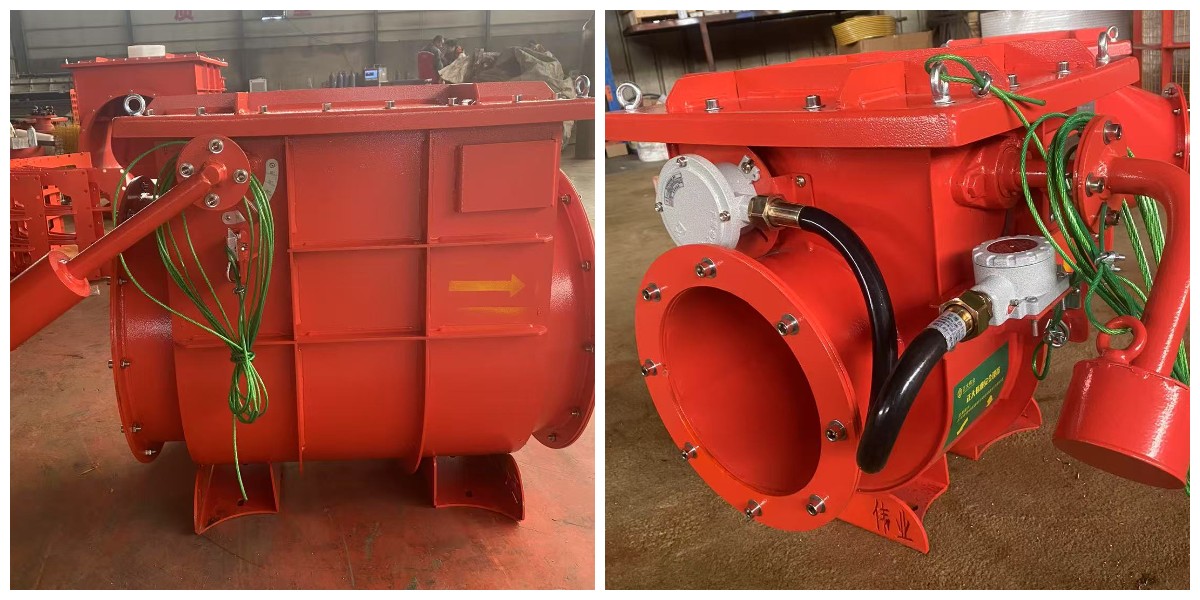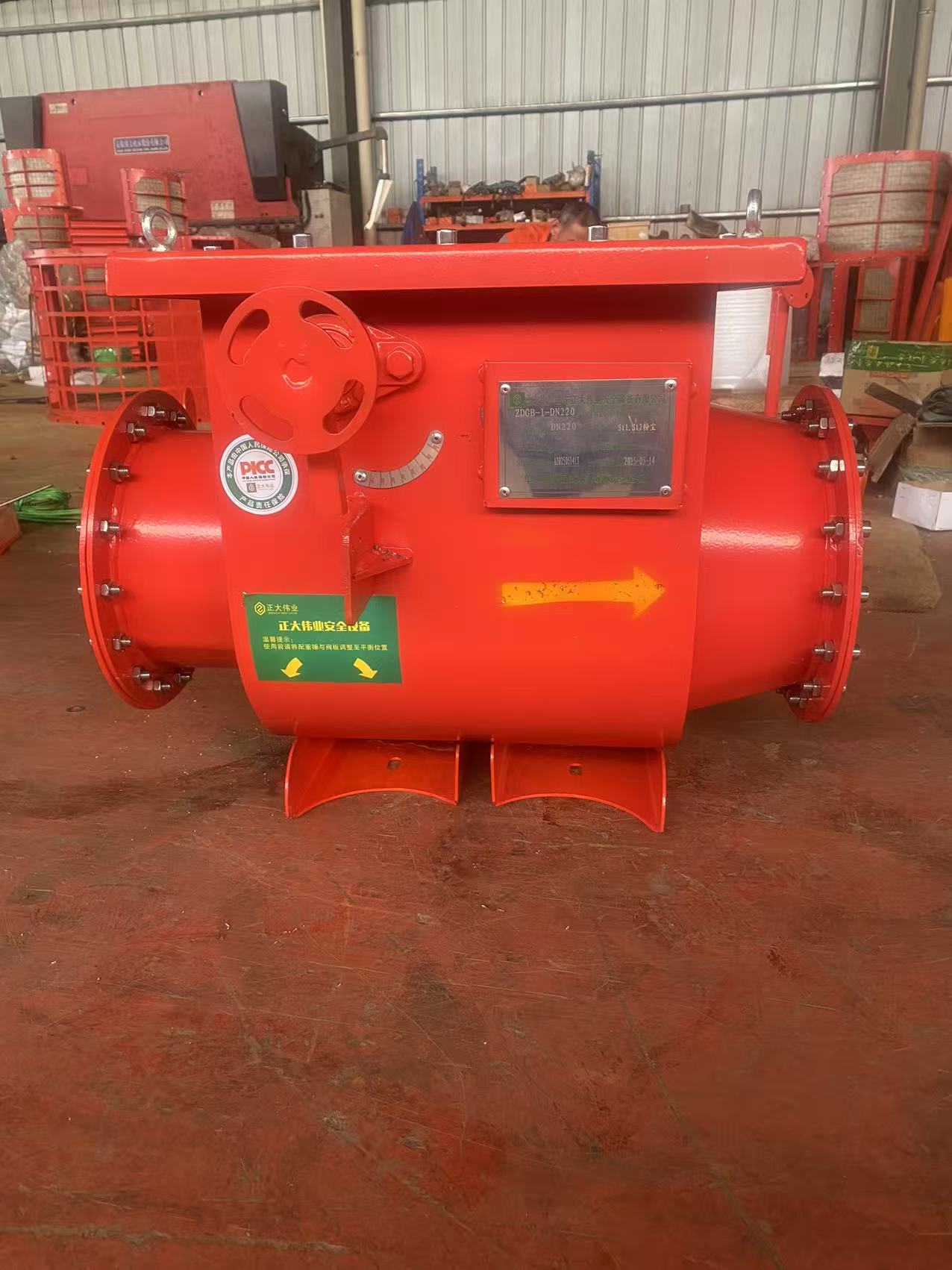
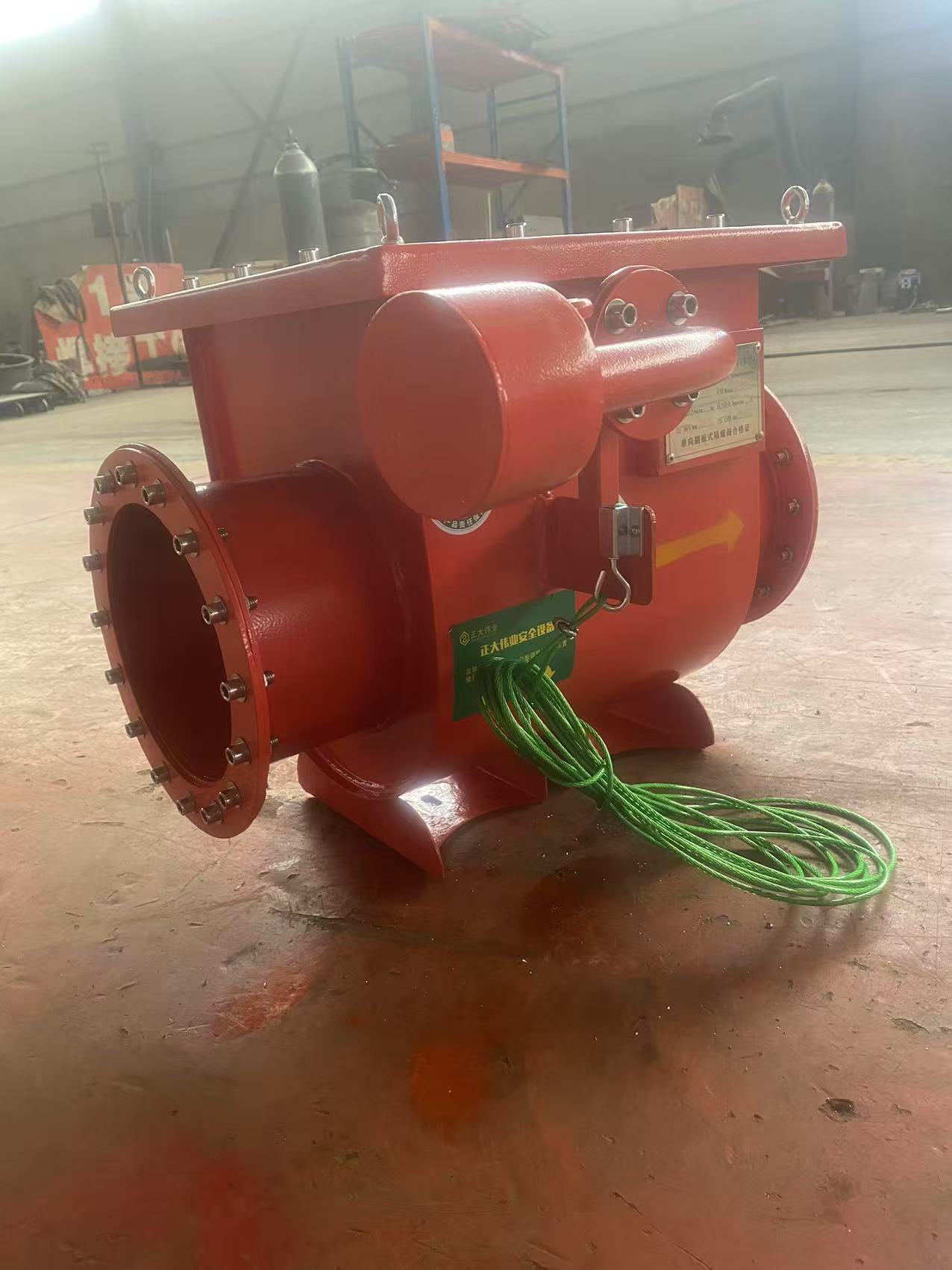
Explosion-Proof Isolation Safety Valve
Build Materials: Carbon Steel Housing with Stainless Steel Closure Flap
System Backpressure: ≤500 Pa at an airflow rate of 25 meters per second
Maintenance can be performed on location; complete pipeline disassembly is not necessary
Primary mounting orientation is horizontal; vertical flow installation is an available alternative
Features a default-open flap design; integration of a detonation sensor for closure verification is optional
Includes a patented latching system to prevent seal rebound
Actuation via electromagnetic system guarantees ultra-rapid closure
The interior surface is contoured to ensure smooth flow and inhibit dust adherence
Product Details
Overview and Purpose
Modern industrial facilities often comprise networks of interconnected vessels and ducting. While efficient for processing, this connectivity introduces a significant risk: an explosion in one unit can propagate flame and overpressure through these conduits to neighboring equipment, resulting in devastating secondary events. The deployment of an explosion-proof isolation safety valve is a primary defense mechanism, designed to sever this pathway instantaneously, thereby containing the initial incident and safeguarding interconnected plant areas and personnel.
This engineered safety component serves as an automatic fire block within industrial conveyance systems. Its fundamental objective is to detect and arrest the reverse travel of explosive pressure and flame through pipelines, acting as a critical safeguard for downstream assets and contributing to a facility's overall layer of protection analysis (LOPA).
Core Product Attributes
Instantaneous Hazard Mitigation: Designed to react to the initial overpressure pulse of an explosion, achieving full closure in milliseconds to block the ensuing flame front.
Construction for Challenging Environments: Manufactured from robust, selected alloys, the valve maintains operational integrity across a spectrum of temperatures, pressures, and in corrosive or dust-laden atmospheres.
Engineered for Practicality: A compact and relatively lightweight design simplifies integration into new or existing piping layouts and reduces structural support demands.
Smart Functionality: Advanced configurations offer digital feedback (e.g., open/close status signals) for seamless integration into plant-wide safety instrumented systems (SIS) or control rooms.
Superior Containment Capability
The valve's effectiveness is rooted in its low-inertia flap and highly sensitive release mechanism, enabling it to meet stringent industry response time criteria. This rapid action is proven to contain explosions with high efficiency, directly limiting potential asset damage and operational downtime. For instance, in a spray drying process handling flammable powders, the valve can isolate the dryer from a duct-borne fire.
Durability for Demanding Service
The use of corrosion-resistant materials and precision manufacturing ensures long-term reliability in harsh operating conditions. This focus on durability translates to extended service intervals, predictable maintenance, and a lower total cost of safety ownership.
Minimal Process Interference
During normal operation, the flap is secured in the fully open position, engineered to introduce negligible flow resistance. This ensures that system performance metrics—such as conveyance rate and fan energy consumption—remain optimal, while the safety function remains passively ready.
Hazardous Location Certified Enclosure
Approved Pressure Rise Detector
Function and Sequence of Operation
The valve operates on the principle that the pressure wave from an explosion travels faster than the flame. It incorporates a sensor calibrated to this initial pressure spike. Upon detection, the sensor triggers the release of the holding mechanism, allowing the flap to swing shut under controlled force. A positive-action mechanical lock then engages, securing the flap in the closed position to withstand sustained pressure and block flame penetration.
Following an incident and after the area is declared safe, the valve can be manually reset by authorized personnel. A basic visual inspection and functional check are recommended prior to returning the system to service. During standard operation, a low-energy system (e.g., a small magnet) maintains the flap in the open position.
Technical Specifications and Dimensions
Nominal Diameter (DN) External Footprint L × W × H (mm) Explosion Protection Level
DN100 409 × 324 × 497 ST1, ST2
DN150 587 × 386 × 550 ST1, ST2
DN200 587 × 386 × 550 ST1, ST2
DN250 628 × 443 × 624 ST1, ST2
DN300 778 × 507 × 693 ST1, ST2
DN350 868 × 641 × 788 ST1, ST2
DN400 946 × 641 × 813 ST1, ST2
DN450 1093 × 795 × 922 ST1, ST2
DN500 1093 × 795 × 922 ST1, ST2
DN550 1240 × 885 × 1020 ST1, ST2
DN600 1240 × 885 × 1074 ST1, ST2
DN650 1300 × 989 × 1191 ST1
DN700 1390 × 989 × 1191 ST1
Optional Accessories
Blast Initiation Sensor: High-Energy (HE) Detection Type
Operating and Maintenance Guidelines
Pre-Startup Verification: Always verify the valve flap is in the confirmed "OPEN" position before activating any equipment that will create flow through the protected pipeline section.
Scheduled Preventive Maintenance: Establish a routine inspection program with a minimum monthly frequency. In environments with high particulate loading or vibration, consider more frequent checks of the moving components and latch mechanism.
Post-Service Validation: After any maintenance activity, perform a full operational cycle test (open-close-latch) to ensure proper functionality before system recommissioning.
Manufacturer Information
Shandong Zhengda Weiye Safety Equipment Co., Ltd. is a specialized provider of industrial safety solutions, with a core focus on explosion protection and pressure relief technology. We develop and manufacture a comprehensive range of safety devices.
Our product lineup includes precision rupture discs, safety and relief valves, flame arresters, and complete explosion isolation systems.
Operating from our facility in Jinan, we combine R&D with disciplined manufacturing to deliver reliable products. We have a proven track record of assisting enterprises in meeting safety compliance requirements. Our commitment is validated by holding the Chinese Special Equipment Manufacturing License, ISO 9001 Quality Management System certification, and relevant national explosion-proof product approvals.