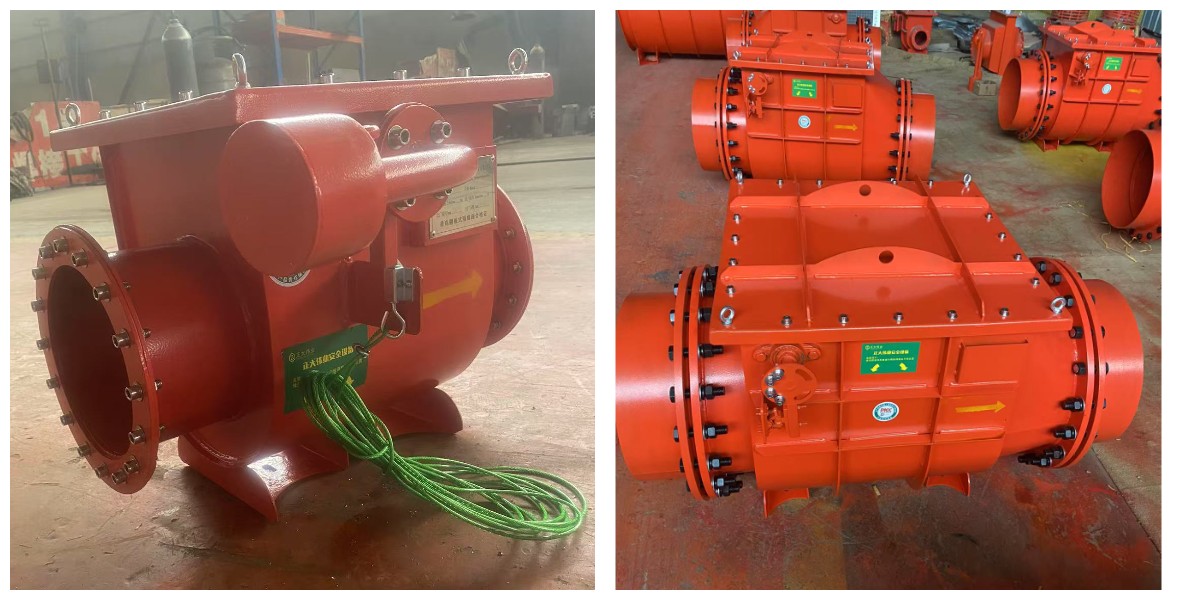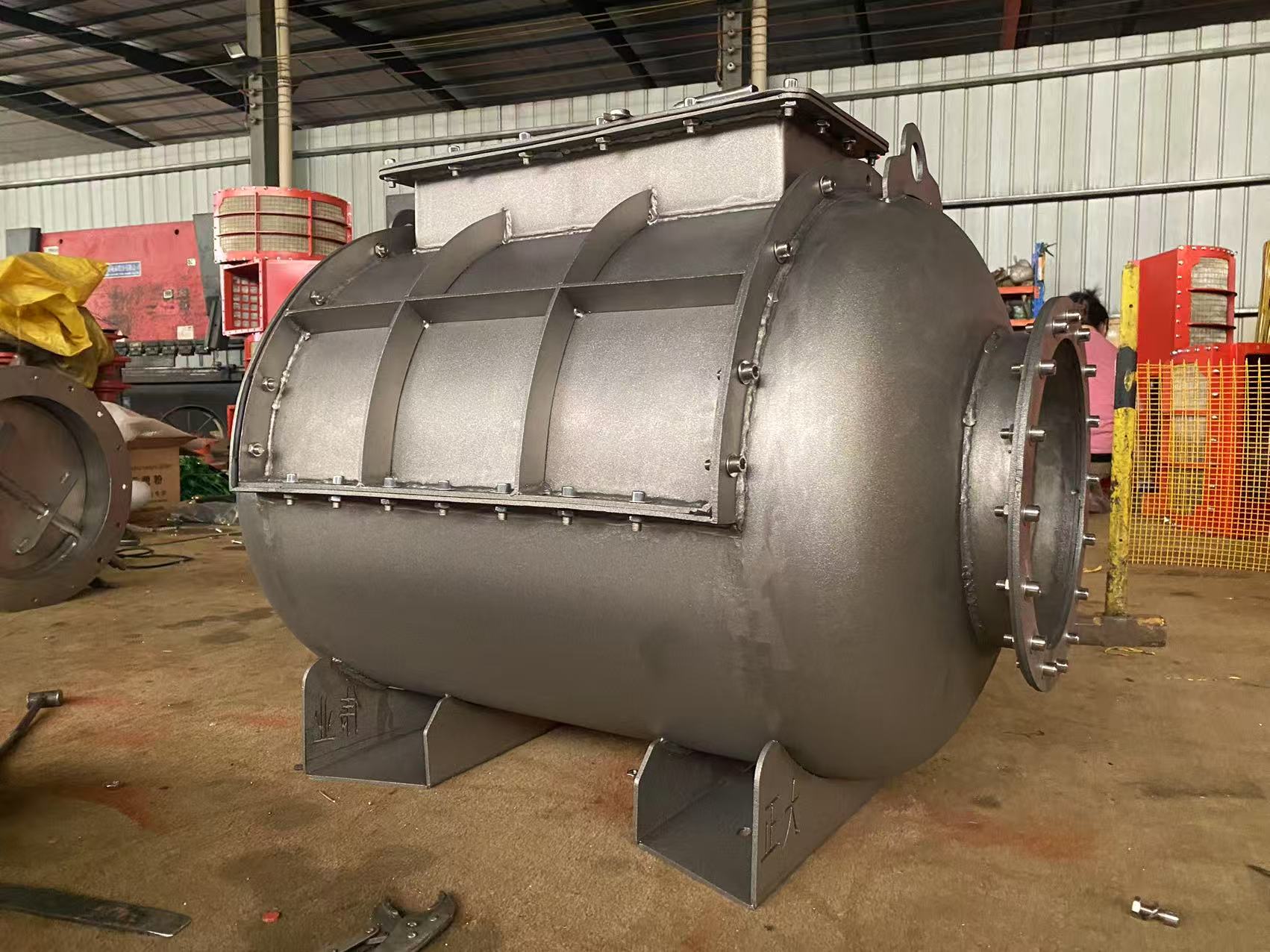
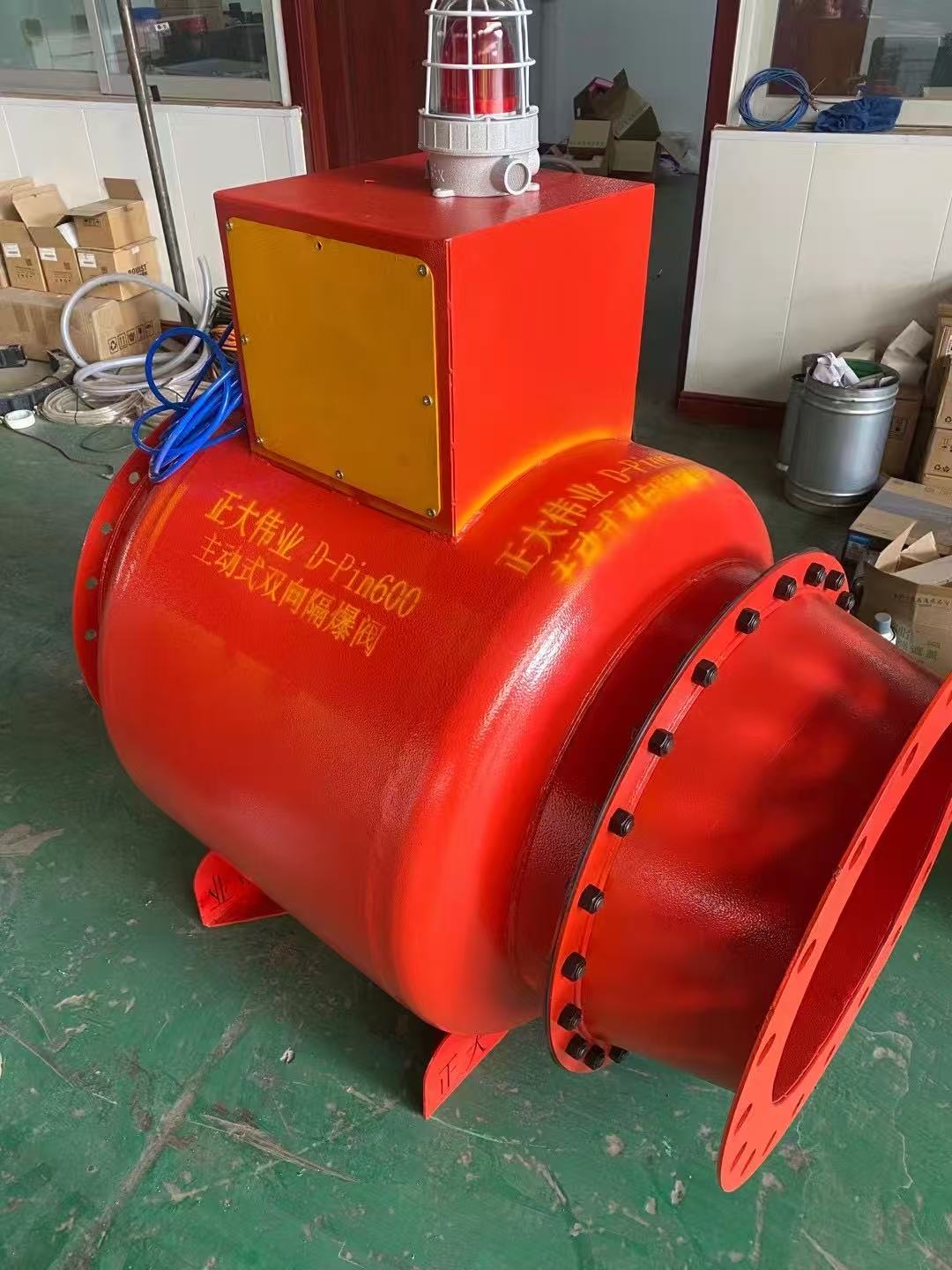
Industrial Process Explosion Cut-Off Valve
Materials of Construction: Housing: Carbon Steel, Internal Closure: Stainless Steel
Flow Resistance Characteristic: ≤500 Pa pressure drop at 25 m/s duct velocity
Engineered to enable servicing in the field without removing the entire valve assembly from the line
Standard application assumes horizontal pipeline mounting; provisions for vertical installation are available
Design incorporates a normally unobstructed closure member; a blast detection pressure sensor can be fitted for automated monitoring
Includes an integral latching arrangement to secure the valve in the closed position
Deploys an electromagnetic release system to achieve the required fast response
The valve's internal geometry promotes streamlined flow to reduce the potential for particle depositionn
Product Details
Functional Role
Within chemical, pharmaceutical, and food processing plants, interconnected equipment presents a risk of explosion propagation. A primary event in a reactor, dryer, or collector can send a flame jet through connecting pipes to other vessels. An industrial process explosion cut-off valve is installed to act as a fast-closing guillotine in these conduits. Its purpose is to automatically sense the event and physically sever the connection, isolating the affected volume and preventing secondary ignitions.
This specialized valve serves as a key safety component in process piping systems where flammable atmospheres may exist. It is designed to automatically halt the spread of explosions, thereby protecting interconnected equipment, infrastructure, and personnel.
Salient Characteristics
Automatic Explosion Interruption: Reacts autonomously to the pressure signature of an explosion, moving from full-open to sealed shut in a time frame designed to outpace flame travel.
Robust Design for Industrial Service: Built from materials compatible with a wide range of process media and capable of withstanding the thermal and mechanical loads of an explosion event.
Practical Installation and Upkeep: Designed with consideration for plant ergonomics, facilitating installation in often-congested pipe racks and allowing for component access without full removal.
Status Indication Capability: Can be supplied with auxiliary contacts or proximity switches to provide a remote signal (e.g., to a DCS) indicating whether the valve is open or tripped closed.
Effective Explosion Segregation
The valve's performance hinges on a carefully balanced closure element and a trigger with minimal delay. This allows it to achieve the rapid closure necessary to act as an effective explosion barrier, a requirement in safety standards such as ATEX directives for equipment used in explosive atmospheres.
Constructed for Long-Term Dependability
Focus on material selection, surface finishes, and mechanical design ensures the valve provides reliable service over many years, contributing to lower lifecycle costs and consistent safety performance.
Unimpeded Normal Process Conditions
During standard operation, the valve presents a full-flow opening, designed to have a negligible impact on system pressure drop and flow characteristics. The safety function remains entirely passive until activated.
Explosion-Proof Rated Component Housing
Certified Pressure Wave Detection Sensor
Mode of Action
The valve functions by detecting the initial overpressure wave generated at the onset of an explosion. A sensor dedicated to this purpose provides the trigger signal. This signal releases the closure member, which is then driven to its sealed position by a spring or gravity. Once closed, a mechanical lock engages to hold it securely against the pressure, preventing rebound and ensuring a tight seal against flames.
Following an incident, the valve allows for a straightforward reset procedure. After ensuring the environment is safe, personnel can manually reset the mechanism. A simple operational check is advised before the system is restarted. The valve is held open during normal operation by a low-force retention mechanism.
Technical Data
Pipe Connection Size Overall Dimensions Explosion Isolation Capability
DN100 409 × 324 × 497 ST1, ST2
DN150 587 × 386 × 550 ST1, ST2
DN200 587 × 386 × 550 ST1, ST2
DN250 628 × 443 × 624 ST1, ST2
DN300 778 × 507 × 693 ST1, ST2
DN350 868 × 641 × 788 ST1, ST2
DN400 946 × 641 × 813 ST1, ST2
DN450 1093 × 795 × 922 ST1, ST2
DN500 1093 × 795 × 922 ST1, ST2
DN550 1240 × 885 × 1020 ST1, ST2
DN600 1240 × 885 × 1074 ST1, ST2
DN650 1300 × 989 × 1191 ST1
DN700 1390 × 989 × 1191 ST1
Associated Detection Equipment
Pressure Surge Sensor: Designated as HE Series (standard offering)
Operational and Servicing Instructions
System Commissioning Check: As a critical safety pre-start step, always confirm the valve's closure member is free and in the fully open position.
Planned Maintenance Regime: Institute a regular inspection and testing schedule, with monthly visual inspections recommended as a minimum. The schedule should be adjusted based on operational severity.
Validation After Service: Any maintenance work must be followed by a functional test to confirm proper opening, closing, and latching action prior to returning the system to operational status.
About the Manufacturer
Shandong Zhengda Weiye Safety Equipment Co., Ltd. is a dedicated supplier of engineered safety solutions for industrial pressure and explosion hazards. Our product development focuses on reliability and compliance.
We manufacture an extensive range of safety devices, from simple rupture discs to complex explosion isolation and suppression systems.
Our operations are centered in Jinan, where we maintain capabilities in design, testing, and production. We serve numerous industries across China, providing products that help manage risk. Our company holds the necessary Special Equipment Manufacturing License of China and is certified to ISO 9001 standards.